Field of Science

#MicroTwJC Part 1: Pushing the envelope of Broad Spectrum Antivirals

This week in Microbiology Twitter Journal Club, we will delve into the search for new weapons in our fight against viruses. This is going to be a two part analysis of the drug LJ-001. Today, we are going to look at the paper in which it was first discovered, and tomorrow we'll look at the follow up to this paper.
Let us say that you are afflicted by the common cold, a set of symptoms that are triggered by a number of different rapidly evolving viruses for which there is currently no cure. The only way one could cure it is if you had a drug that could hit every single one of these viruses. In fact, if you were to describe the whole family of different viruses in terms of a rainbow, the kind of treatment you need is one that will hit the whole spectrum.
What you need is a broad spectrum antiviral.
I've previously talked about one class of antivirals known as DRACO's, which have a side effect of killing the virus by killing the cells they inhabit, effecting a scorched earth policy against the virus. 
Today, we'll be looking at another drug that could potentially fight off a broad spectrum of viruses.

So how do we go about finding new drugs to fight viruses ?

I have previously talked (at some length) about how DRACO's were developed, based on examining natural processes, and developing a drug that manipulated those processes for our own ends. But this is not actually how many drugs are discovered. If we look at the history of antibiotic discovery, we find that many of them were discovered through testing every chemical available until we find one that does what we want it to do. As I like to call it "Throw S**t against the wall and seeing what sticks" approach to drug discovery. But that makes it sound too easy. You need to be very careful about the kind of shit you're using, and you need to be smart about the wall you're throwing it against. Otherwise you could spend you entire life throwing shit against a wall with naught to show for it except sticky hands and a vastly reduced social circle.

These researchers started out searching for chemicals that can prevent an engineered Vesicular Stomatitis Virus (VSV) entering into kidney epithelial cells extracted from the African Green Monkey, known as "Vero cells". These engineered viruses have a gene encoding luminescence, which means that when they successfully infect a Vero cell, they start emitting light. If the Vero cells don't emit light, and are still alive at the end of the experiment, then something has stopped the virus from infecting the cell. It is a relatively rapid system for quickly testing out drugs to stop viruses infecting cells.

The researchers initially wanted to develop a new drug against Nipah virus, which is related to the VSV test virus used in this experiment. They created the "LJ-series" of compounds. The researchers don't go into the rationale behind their choice of compounds, but to be fair the only one they need is that these compounds haven't been tested before.
After what I presume was strenuous testing*, they eventually discovered a compound that stopped VSV from infecting Vero cells. This compound was named LJ-001.
So then the researchers tested it out against the Nipah virus, and found that this compound was just as effective at preventing Nipah virus from infecting  Vero cells.
The key graph is below, shown in A, with the black and dotted lines representing the VSV and Nipah viruses respectively, and the dashed line showing the control cells that were not infected with viruses.


Panel B shows what happens over time if you add the VSV to Vero cells over a time course with and without LJ-001 and measure the numbers of viruses produced by infected cells. The LJ-001 puts a real crimp in the production of viruses. 
In even better news, Panel C shows that LJ-001 will only start showing signs of toxicity at concentrations of log10 -4, which is the highest value shown in Graph A.

So this is good news. But it gets better. The researchers then tested to see whether this compound could prevent other viruses infecting Vero cells. It was effective against enveloped viruses like HIV, Influenza, Hepatitis C, and even Ebola. But when it came to Adenoviruses (which often cause the common cold) it didn't work. It was a shame, but it told the researchers something very important about LJ-001, and how it works.
Viruses like Influenza, HIV, Hepatitis C and Ebola have a coating of fatty lipids. Lipids coat the surface of human cells as well. The lipid envelope of theses viruses can fuse with the lipid surface of human cells to help the viruses enter the cells.
But adenoviruses don't have a lipid envelope, and enter human cells using a different system.
So the evidence suggests that LJ-001 works by preventing viruses enveloped with lipids from fusing with their targets on human cells.

So is LJ-001 binding to a target on the host cell, or on the virus ?


Panel A-C. The researchers added the LJ-001 before infection, and measured how well they infected the cells. The earlier they added LJ-001 to the virus, the less able it was to infect cells. If they added it just to the viruses before they infected the cells, it prevented the viruses from working. This strongly suggests that the LJ-001 acts directly on the viruses.
Panel D. They treated viruses such as the rift valley fever and Ebola with LJ-001 before using them to infect mice. Now, in real life viruses don't tend to take baths in antiviral drugs before infections, so don't assume that this graph will in any way represent how treatments would actually progress. It does however fully support the idea that LJ-001 is acting on the virus directly, and not the host.

Now that this has been established, the question arises as to what LJ-001 actually does to the membrane of the virus. The great thing about LJ-001 is that it naturally fluoresces at 510nm when it is dissolved in lipids, so they can actually measure how much LJ-001 insinuates within a membrane by seeing how fluorescent the membrane becomes.


Panel A. We can see an example of this. They have a set of Liposomes, which are basically pure lipid membranes with no virus or anything in them. When these are added to the LJ-001, we can see that there is a strong fluorescent signal with a wavelength spectrum centered on 510nm.
Panel B.  They add differing concentrations of the liposomes to LJ-001. The luminescence signals from these indicate that the LJ-001 has dissolved within them, and thus become fluorescent.
Panel C They took Vero cells and added differing concentrations of LJ-001 to them, and then measured their fluorescent signal. Not only does this demonstrate that LJ-001 can enter the membranes of host cells, but that we can determine the amount of LJ-001 in the membranes of Vero cells using the fluorescence signal. 
Panel D. Now we have the bioluminescent VSV again. Big luminescence signals indicate that it can successfully infect vero cells, low ones indicate no infection. We have two treatment groups, we have LJ-001, and the control. But in this experiment they added liposomes. These liposomes act like a sponge for the LJ-001, and every molecule they suck up is one hat can't attack a virus. So when they are added at higher concentrations, we can see that they prevent LJ-001 from working properly.
Panel E. However, if they did the same experiment where they added the LJ-001 to the viruses before they interacted with the vero cells, then no luminescent signal is recovered, indicating that no infections take place.

The researchers could now say with some confidence that LJ-001 affects the viral membrane. The question remained as to how it affected the membrane. What was this molecule doing ?

To get an idea about this , they took a closer look at the structure of LJ-001.
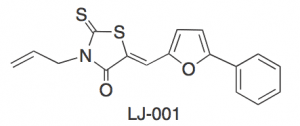
We can assume that different parts of this molecule are somehow attacking the enveloped of the virus. How do we find out which parts of the molecule are important, and which ones are not ?
The scientists performed a structure-activity study to work this out. They created a number of chemicals that were similar to LJ-001, except with a difference in the basic structure. 
I'll give a quick example.  You see on the far left of the structure, there is this big hexagonal ring of carbons. This part is very fatty, and thus can help the compound mix with oily lipids. But if we attach an acid to it, this will give the ring a charge, and make it less able to mix with oily lipids, and better able to mix with water molecules. So if we make a change like this, we can change the properties of different parts of a compound, and then see whether it is still able to fight off viruses. They created 26 of these compounds, and then tested them for their ability to attack viruses. 
They were able to then work out which parts of this molecule allow it to attack viruses, but not human cells.
They found that:
  • The portion of the molecule highlighted in green seemed to have no real purpose, they could add what they liked to it, and it didn't change the antiviral properties of the molecule.
  • The blue portion of the molecule was essential to it's antiviral activity, and could tolerate no changes. The double bod that links it to the orange portion of the molecule is particularly important.
  • As you can tell from the previous, the orange portion of the molecule plays an important role in relation to the blue part. Changes to it reduce the drugs effectiveness.
  • Changes to the red portion of the molecule reduce the drugs effectiveness only if those changes give it a charge. This part of the molecule is essential for allowing the drug to enter the membranes of viruses.
What happens to the virus after it encounters LJ-001?

So the researchers now know which portions of LJ-001 are messing with the virus. But we still don't actually know about its target. all we know is that LJ-001 does "something" within the lipid envelope of the virus, and not much else.
The researchers sought to improve this situation by taking a much closer look at what this drug does to the rift valley fever virus. 
They added the LJ-001 to a sample of virus, and then broke the virus up into it's constituent proteins and ran them on a western blot. In simple terms a western blot is a way for researchers to weigh different proteins found in the virus. If the LJ-001 is binding specifically to one of these proteins, they would become heavier, and this would show up on the western blot. However, none of the proteins they tested became any heavier, suggesting that LJ-001 had a different target. They repeated this experiment with a number of different viruses, and came up with the same results.

What stage of infection is LJ-001 stopping ?

The researchers took some nipah virus treated with LJ-001 and used it to infect some host cells. They added a fluorescent antibody designed to bind to Nipah virus. Cells with Nipah virus attached to them would end up glowing as a result of this antibody.
What they found was interesting. LJ-001 didn't actually prevent the virus from attaching to the surface of their target cells, even though it stopped the virus from actually infecting the cell.
To further delve into this, the researchers needed to take a deeper look at how viruses fuse with the cell membrane, in order to understand how LJ-001 interferes with this process.

The researchers used a specially engineered virus to study this process. This virus, descended from Nipah virus, was engineered to possess special enzyme fused into one of the key proteins within it. If the virus successfully fuses with it's host cell, this enzyme is released into the host cytoplasm. This enzyme reacts with chemicals within the host cell to turn it blue. So the researchers could tell whether the viruses successfully fused with the host cytoplasm by checking out which cells had turned blue.


Panel A shows that LJ-001 prevents virus cell fusion. But the question arises, if it can mess with viruses, could it do the same to host cells that had already been infected with virus ?
Viruses are known to be able to transfer themselves to new cells by causing the host cell to fuse with it's neighbour, creating cells that are known as "syncytia". They infected cells with this special strain of nipah virus, and then added them to uninfected cells in the presence of LJ-001. Panel B shows that they did not prevent the fusion of host cells.

This highlighted that LJ-001 only interferes with the virus lipid layer, and does not seem to damage the host. So the researchers asked themselves "What were the main differences between the lipid layer around the virus, and the lipid layer around a host cell ?"
One of the main differences between viruses and most living things is the presence of an active metabolism. To people particularly interested in classifying things, Viruses in the free living portion of their life cycle are not considered to be alive. If their membranes get damaged, they cannot repair them. Living cells however have an array of different ways to repair their cell membranes when they get damaged.
The researchers hypothesised that the LJ-001 was causing a small degree of damage to the living host cells,  but these cells were able to repair it, as opposed to the viruses, which ended up "dead". If this was the case, then if they stopped the living repair processes of the living host cells, then they would render them vulnerable to the effects of LJ-001 in the way that viruses are naturally vulnerable.
Scroll up to Panel C and you will see how they tested this. They added TOFA, which prevents new lipids from being made, and thus prevents the lipid membrane of the host from being replenished with new lipids after damage has occurred.  So they used a Toxilight assay, in which measures when cells leak adenylate kinase into the medium, which usually occurs when cells are dying.
They added LJ-001 to cells that had been treated with TOFA, and found that this treatment had made the host cells more likely to die off after LJ-001 treatment. This suggests that LJ-001 acts through damaging Lipid layers on all cells, and takes advantage of the lack of membrane repair systems within viruses.

Summary

  •  The discovery of LJ-001, a new antiviral is a great finding in itself. Even if it only affected Nipah virus, or VSV, it would be a cool discovery.
  • The fact that it can hit the whole spectrum of  enveloped viruses is brilliant.
  • We know that it can attack some target within the membrane, and that the only way we currenlty know that viruses can overcome this resistance would be to either completely lose the envelope, or to develop membrane repair mechanisms like living cells.
Statistics
They use students T-test for all of their comparisons (according to their methods), which actually is not problematic for most of their analyses. Figure 2 A is the only ones where this is may be a problem, because they appear to compare more than two groups. This requires a correction for multiple comparisons, to avoid a type 1 error.  The reason I don't think this will be much of a problem is because I decided to do my own Bonferroni correction (assuming they used n=10), which basically sets the p-value at a new level to take the multiple comparisons into account. This means that they would now need to get a p-value lower than 0.005 in order for them to be able to declare the results significant. For those experiments, they got p< 0.001. 
So the paper's statistics are actually pretty good (for a microbiology paper) for the experiments in which they were used.

Lingering questions
  • What is the LJ-001 doing to the virus membrane ? We know it is causing damage, but how is it doing it ?  
  • Will this actually be a viable treatment ? We have seen how the LJ-001 could be effective if the viruses soak themselves in it before infection ?
  • Does the presence of any lipid layer make this treatment unfeasible ? We have seen how liposomes can nerf the effectiveness of this drug simply by being present.  What will happen to this drug when it is put inside a body in which there are tons of lipid bilayers that will suck up the drug before it manages to even see a virus.
I will be analysing the follow up to this paper tomorrow.

Wolf M.C., Freiberg A.N., Zhang T., Akyol-Ataman Z., Grock A., Hong P.W., Li J., Watson N.F., Fang A.Q. & Aguilar H.C. & (2010). A broad-spectrum antiviral targeting entry of enveloped viruses, Proceedings of the National Academy of Sciences, 107 (7) 3157-3162. DOI:

Microbiology Twitter journal club will start this Tuesday, 8pm BST 
follow the #microtwjc hastag.


*I do not know this for certain, but suspect the author list is as long as it is because so many of them must have worked on the screening process, and through no fault of their own turned up with nothing, but the lead authors want to acknowledge the sacrifice of the scientists who came before. This is the ultimate risk of "sh*t against the wall" research for academia.

TMI Friday: Discount Silicon Implants

This weeks unfortunate tale revolves around a 26 year old woman who turned up to Addenbrookes hospital, Cambridge in 1975 with a peculiar condition. The woman reported that for around 6 months , she had been bleeding out of her left nipple. To quote the doctors :
On examination she looked extremely pale and was breathless on exertion. The left side of her brassiere was full of clotted blood. The right breast was normal, but on the left side the nipple was excoriated and was oozing bright blood from several areas.
The woman needed to be transfused with 4 units (~2 litres-ish) of blood to keep her conscious. The doctors then looked for cancerous lumps. When they couldn't feel lumps, they cut out the whole damaged left nipple. This allowed them to sow up the wound, and stop the bleeding. But the question remained, what was causing the bleeding ?
So they analysed the nipple under a microscope, and find out what was making it bleed so much. The doctors found that the nipple had been subjected to a lot of trauma, over s long period of time.
 The patient may have been suffering from "Dermatitis artefacta". This is a disorder that occurs when patients excessively scratch or irritate their skin. Sufferers of this disorder seek out medical attention out of some subconscious need. But that isn't the weirdest part of the story. 


The story gets weird one month later when the patient returned, complaining of a painful lump in her left breast. Maybe the physicians were wrong. Perhaps they had misdiagnosed this patient, and she had cancer after all. The wound from the nipple excision had not fully healed and was spewing a disgusting yellow pus. 
The left breast had become heavier than the right one. 
They took an X-ray,  revealing a large calcified mass (shown above). Calcified masses can develop in the breast as a result of cancer. Irritated tissues accumulate calcium to create hard lumps which show up in white on X-rays. But usually, these lumps are very small. The calcified lumps on this woman's X-ray were massive in comparison.
So the decision was made. They needed to operate. The surgeons cut open the breast at the position just above the lumps, and found something very odd. These lumps were not what the surgeons thought they were.
One by one, the surgeons pulled out approximately fifty stones, mixed together with sand and gravel, which had apparently been inserted into the initial biopsy wound.
Upon being confronted with this incongruity, the patient did what I imagine many patients featuring in TMI Friday would do if they had the chance. She discharged herself from the hospital, offering no explanation as to what occurred and why.

Sampson D. (1975). An unusual self-inflicted injury of the breast, Postgraduate Medical Journal, 51 (592) 116-118. DOI:

What reading a scientific paper reveals about you

What do you believe science is ? How do you think that belief affects your life ?
One way of answering t comes from the way we treat the foundation upon which modern science is built.
The medium that scientists use to communicate their discoveries is the scientific paper. These documents have evolved over the centuries to adapt to the way that science itself has changed. The first scientific journals came into being in the 17th century, in a time when science was more of a hobby for the aristocracy than a significant career in itself. These early papers lack much of the structure of modern journals, and can be disconcertingly easy to read compared to their modern counterparts. But as science became more professional, readers demanded greater transparency to allow them to replicate the experiments they read in the journals, the modern scientific paper came into being.  I'm going to make a fairly big generalisation by saying a scientific paper's structure* consists of five parts 
  • Introduction- Where the authors explain the background of their research. This will reveal to the reader the questions that they intend to ask during their paper, and why those questions may be important.
  • Methods- This is where the authors explain how they are going to use the materials they have to hand to answer the questions they have posed in the introduction. This is the part where they put in a lot of the important details of how they set up their experiments.
  • Results- Here, the authors explain what they have observed from their experiments, usually in some detail. A savvy reader should be able to see how these observations contribute to answering the overarching "question" of the paper. But for those who can't, there is always...
  • The Discussion. Where the authors explain how their observations fit in with what everyone else has published in the scientific literature. They can also take this opportunity to point out where their experiments fall short, and what other questions have been raised or left unanswered by their work.
  • References. In any academic article, it is important to cite the work of others, so that the readers can find their work and verify that the author is actually representing it properly, or not. It also allows the author to make their article shorter, simply by pointing to other works which may have already explained their experimental procedures and the concepts they are working with. These are also incredibly important for recognising others in the field who have contributed important research.
When I first started reading papers, it was for writing up specific essays or dissertations. I learned early on that if you spam your bibliography with enough references, you would get better grades. To insure against disaster, such as someone actually reading the reference section, I would read over the abstract to see whether it backed up whatever point I was trying to make.
Soon, my technique had advance to the point where I would read the abstract and the introduction, and then skip to the discussion. I saved time by ignoring the parts of the paper which I didn't understand, and could still competently comment on its findings. I could "read" a ton of papers using this technique, and still had plenty of time to go out partying. I had hacked my undergraduate degree.
Things changed when I started working in a scientific lab. If I wanted to learn a new scientific technique, I had to delve into the methods and the results sections of academic papers. Before I could easily transcribe what the authors of these papers wanted to say by reading the introduction and discussion.  Now, I could put myself in their shoes, and see how they decided to answer the questions posed in the paper. I could see how I could do things differently, and more importantly I could see when someone was doing something better, and then use that for my own work. Soon I realised that I wasn't getting the whole picture the way I read academic papers previously. It was not just about reading the methods and the results, it was also about delving through the references sections, to immerse oneself entirely into the experience. Only then can you see the potential gaps in knowledge left by a paper and fully understand what it is actually saying.

But you didn't start reading this for me to tell you what a scientific paper is, or to learn my life story. You want me to tell you about what reading a scientific paper reveals about you, and what you believe science is.
I still run into scientists who only read the introduction and discussions of papers without ever fully engaging with the content. By doing that, they have implicitly made the decision that science is a collection of facts arbitrarily espoused from on high that need to be memorised.
But if you believe that science is more like conversation based on careful analysis of the evidence, then you need to engage with the evidence presented within the paper. If you do manage to delve into these parts of the paper, if you use every tool available to you to understand a paper, to put yourself in the authors shoes, then you'll see the problems they faced as they did, and how they overcame them.
Without that insight, without that knowledge of what goes into science, we end up losing out, and the discourse on science is the worse for it.


*I should note that your mileage may vary for this structure. There are some shorter papers which dispense entirely with the methods, and include them all with the results. If you are reading the medical literature, you may come across case reports, which have a slightly different structure because often the Doctor doesn't seek out the question, the question finds them in the form of a patient with an odd manifestation of a disease.
 If you are reading a paper with no results or methods, then the document you are holding is most likely a review of the literature, and completely different to the kinds of articles we are discussing here.

TMI Friday: Smell This !

Imagine that you have just been recruited into a study. The researcher sits in front of you, impassively. You are presented with a series of bottles, and asked to judge the smell of each one of them on the basis of how "pleasant" they are, and how "Intense" they are. You shrug, and do your best. You are being asked for your subjective estimate, and you give it. None of the smells is particularly pleasant, and some are quite intense.
You rate them on a scale, with negative values denoting whether you disliked the smell, and positive if you liked it.
But what are you, and the other participants smelling, and what did the researchers want to learn from this experiment ?
This experiment was performed in 1975, at about the time when a lot of researchers became interested in whether human being produced pheromones like other mammals do*. So this experiment was part of a grander push, to single out what role odour plays in human interactions.
So the researchers wanted to know whether people "liked" the odours they had presented. The researchers didn't tell them until after the trial, although many of the participants has their own beliefs on what they were being tested on.
To quote the article :
Several observers spontaneously told us we were studying either deodorizing products, cheeses, or preservatives for food such as turkey or fish
But this was not the case. The observers were in fact being asked to smell vaginal secretions.
The researchers had recruited four volunteers, we are calling them A B C and D. The samples were taken every other day throughout each volunteers menstrual cycle using a tampon. They did this for four cycles, all while recording their sexual activities.

The researchers also had other requirements for the volunteers:

Use of vaginal deodorants or douches was prohibited during the study, as was the eating of asparagus, garlic, and onions. The eating of broccoli, brussel sprouts, cabbage, chili, curry, kale, pineapple, and sauerkraut was discouraged.
 The researchers then put the used tampons in the bottles, to place under the noses of unsuspecting volunteers.
Here are the results that the researchers found:

The top graph shows intensity, and the bottom graph shows pleasantness. These values are based on the ratings of the volunteers, who gave negative values to the smells they disliked. You may also wish to note that there were no positive values on the pleasantness graph, or as I prefer to refer to it, the "least unpleasant" graph. On the day in which the smells were rated the "least unpleasant" also happened to be the days in which the volunteers marked them as the least intense. However, these all appeared to occur during the 3rd phase of the menstrual cycle, the ovulatory phase.
But we are only scratching the surface here. Let us look at how the volunteers rated each individual donor. throughout the study.

Here, we can actually see that there is a lot more variation in how the respondents actually perceived the odors, with volunteers A and B managing to get positive scores on the pleasantness scale. But as the respondents progressed through the study, their odours were judged to be less pleasant. This may be a side effect of the researcher's sampling strategy i.e. tampons really are not meant to be used for nearly every day of the week.
 The first graph appears to completely shoot that down the idea of human pheromones, with smells obtained from all points of the cycle scoring below the pleasantness scale**.The fact that they only used four volunteers, and that they didn't see any gender specific effect really suggests that no pheromones were present. I don't know about you, but I think something smells funky about this.

Doty R., Ford M., Preti G. & Huggins G. (1975). Changes in the intensity and pleasantness of human vaginal odors during the menstrual cycle, Science, 190 (4221) 1316-1318. DOI:

* Many mammal species possess a special pheromone sensing organ within their nose known as the "vomeronasal" organ. The organ is much reduced in humans to the point where it is likely vestigial. I haven't had the chance to delve into the literature yet, but it seems to be a general consensus that humans don't use pheromones, unless they want to sell a specific brand of perfume.
** Respond in the comments if can guess why this data, encompassing the data from all of the women from the entirety of the experiment might actually have been skewed downwards.

TMI Friday: A Cock gets bitten by a Pig

There is a certain kind of individual who dreams of retiring and opening a farm. The idea of escaping to the country, buying a small cottage and raising sheep and pigs. Oddly enough, many of these people appear to have been raised in the city, and have very little experience of mucking out a pig pen.
But the rural dream can turn into a nightmare. Especially in the case that we are about to discuss.
A 28 year old man was working with pigs. During the course of his work, he had to catch a piglet (ungreased). Pigs can actually run deceptively fast, reaching a top speed of 11 miles per hour.
So this task is difficult enough. But then we have to take into consideration that this was a baby pig, and that pig mothers can be very protective. Not only would one have to run fast enough to catch the piglet, but fast enough to escape the enraged sow that will no doubt be in hot pursuit.
Such was the fate of the subject of this paper. In the process of trying to capture a piglet, it's mother wrought the worst kin of vengeance. It clamped its jaws around his crotch.
Now I should clarify that it did not bite his penis off.  Instead, it inflicted an injury known as a "Degloving ". If I were to draw you a picture, it would probably be one with an adorable snake wearing an equally adorable custom made jumper pulled off of it.  Except the jumper being removed is actually human skin, and the snake is actually a writhing collection of bloody viscera.
The surgeons cleaned out the wound and realised that most of the "degloved" skin had already died. They replaced it with a skin graft from the patients thigh. The paper tells us that the patient could resume his sexual life 1 month after the operation.
We may never truly know the full story of the pig. Perhaps it broke it's bonds, and roams free in the countryside exacting traumatic revenge on nervous male adolescents. Perhaps it prowls the corridors of parliament, adding fears of literal emasculation as well as metaphorical emasculation to liberal democrats. As you read this, you may notice the quiet sensation, a warm wet breath across your nether regions, and you realise that it is standing under your desk, just waiting for you to look down so it can see your expression when it strikes.

Georgiou P., Liakopoulos P., Gamatsi E. & Komninakis E. (2001). Degloving Injury of The Penis from Pig Bite, Plastic and Reconstructive Surgery, 108 (3) 807. DOI:

TMI Friday: Oh, How long has that been there ?

I remember searching through an old jacket, and finding a torchlight within it. It had been in that jacket so long that I forgot that I had even lost it. I'm sure we've all been in that situation of finding something long after it had been lost, that combination of surprise and relief when it is found.
So let us put ourselves in the shoes of the 62 year old widow who wondered into an Accident and Emergency unit in Stockport. She had been experiencing horrible smelling bloody discharge from her "Intimate area". But after a bit of questioning, it turned out that there were some complications. It was a long term issue, and she had been too embarrassed to seek medical help.
It was her new boyfriend who had convinced her to go to hospital and finally see a Doctor about it. 
Three years before, she was using a vibrator when the device got lodged up her vagina. She was completely unable to extract it. 
I was told of a similar situation, of a gentleman who had come into A & E with a similar problem. The gentleman was in intense pain, and after the surgeons had worked out the cause, they tired removing it. They soon realised that this would be impossible. Because the Vibrator he had inserted into his body was still fully activated. It was too far inside the man for anyone to reach the switch and turn it off. So they had to keep this gentleman waiting in the emergency room until the damned things batteries ran out.
So this ladies decision to wait may not have been a completely silly decision. However, leaving a vibrator  marinating in her vagina for three years before seeking medical attention was a little bit extreme. 
In fact, it was incredibly dangerous. It had worked its way through the vaginal wall and into the rectum, causing a horrible condition known as a rectal fistula. The damage the vibrator had caused to her digestive system was so severe that she had to undergo a colostomy.  This is usually done when a large part of the intestine is no longer able function, and a new opening needs to be made to allow faeces to leave the digestive system. Although drastic, this was enough to stop her condition get any worse.

And so ends Girls month. I hope you've enjoyed reading about all of the embarrassing things that the "fairer" sex get up to. Next week we'll be returning to the embarrassing world of men. But make no mistake, if I hear an embarrassing story involving a woman, I will not wait to have another girls month to tell you about it.

Ahmad M. Intravaginal vibrator of long duration., European journal of emergency medicine : official journal of the European Society for Emergency Medicine, PMID:

#MicroTwJC: Bacteria in SPAAAAACE !!

In 2011, Stephen Hawking declared that humanity may not survive to see the next millenium "without escaping beyond our fragile planet." That may seem like an overly dramatic statement, but there is some truth to it. As long as we confine ourselves to earth, we tie our fate to the fate of this world. It is a big uncaring universe containing unstoppable threats that can any time blast us from the surface of this world.
If we want to ensure that our species survives, we need to colonise space. This is a challenge that no other life form (as far as we know) has achieved. There are no environments on earth that can possibly prepare us for the fatigues of space. We evolved without having to worry about radiation, within the constant grasp of gravity. If we are to make space our home, we need to figure out how to adapt our physiology to make it hospitable.
The paper being reviewed in this weeks Microbiology Twitter Journal Club aims to investigate how our bacteria will be affected when we go into space. Our gut encompasses an entire bacterial ecosystem that is essential to our health, and that we still barely understand. We know that when bacteria adhere to the surfaces within the body, they aggregate together into convoluted structures known as biofilms. These colonies allow the bacteria to communicate with each other, and survive within the harsh environments of the body. A biofilms are critical to bacterial survival within the body, and by proxy, could be crucial to our survival. But what happens to these films when they are grown in space ? 
How do we  even find out ?
It's simple. We go there.